
What Is Hypertension?
For the longest time, I thought high blood pressure was something that only happened to stressed-out executives or people who ate too much salt.
I was wrong.
A decade ago, after years of feeling completely fine, a routine check-up changed everything.
The doctor (who would have been my mother-in-law had she not died earlier) looked at the reading and said, “We need to talk.”
Her tone and told me there was something for me to worry about.
I had hypertension.
And I always kidded that I had high blood pressure because I was an athlete.
Nope.
I had hypertension.
Hypertension — or high blood pressure — is a condition where the force of blood pushing against your artery walls is consistently too high.
Think of your arteries like a garden hose. When the water pressure is too strong for too long, the hose starts to weaken, crack, and eventually burst. The same thing happens inside your body, silently, over years.
According to the World Health Organization, hypertension is diagnosed when blood pressure reaches or exceeds 140/90 mmHg.
The American Heart Association uses a slightly lower threshold of 130/80 mmHg.
Blood pressure is written as two numbers — the top number (systolic) represents the pressure when your heart beats, and the bottom number (diastolic) represents the pressure when your heart rests between beats.
Blood Pressure Classification Chart
| Category | Systolic (mmHg) | Diastolic (mmHg) | Action |
| Normal | Less than 120 | Less than 80 | Maintain healthy habits |
| Elevated | 120–129 | Less than 80 | Lifestyle changes |
| Stage 1 Hypertension | 130–139 | 80–89 | Lifestyle + possible medication |
| Stage 2 Hypertension | 140 or higher | 90 or higher | Medication required |
| Hypertensive Crisis | 180 or higher | 120 or higher | Emergency care immediately |
It’s a Silent Killer
This is the part that scared me the most.
And I may seem like I’m always kidding around when it comes to the subject of death but this one is what truly scares me.
High blood pressure almost never causes symptoms — not until serious damage has already been done.
No headache, no dizziness, no warning sign.
You can have dangerously elevated blood pressure for years and feel completely normal.
The only reliable way to know your blood pressure is to actually check it.
You can do this at a pharmacy, a clinic, or with a validated home blood pressure monitor. Experts recommend checking your blood pressure at least once every two years starting at age 18 — more frequently if you have risk factors or a family history.
How to check your blood pressure correctly:
- Sit quietly for 5 minutes before measuring
- Keep your feet flat on the floor and your arm at heart level
- Take two or three readings, one minute apart
- Check at the same time each day for consistency
- Avoid caffeine, exercise, or smoking for 30 minutes before checking
- Bring your home device to your doctor’s office to verify its accuracy
If your reading is 180/120 mmHg or higher, seek emergency medical care immediately — that is a hypertensive crisis.
How We Develop Hypertension as We Age
Here is the uncomfortable truth about getting older: your arteries age with you, and not always gracefully.
In your 20s and 30s, your arteries are elastic and flexible — they expand and contract smoothly with each heartbeat. But over time, a process called arterial stiffening begins. The walls of your main artery (the aorta) and other large blood vessels gradually become thicker, less flexible, and less able to cushion the pressure of blood flow. This forces your heart to work harder to push blood through, which raises your blood pressure.
Research published in medical journals confirms that aging is an independent risk factor for hypertension.
The prevalence of high blood pressure increases significantly after the age of 40.
In fact, until about age 64, hypertension is more common in men. After age 65, women become more likely to develop it — partly due to hormonal changes after menopause that remove the protective effects of estrogen on blood vessel walls.
Why does this happen biologically? As we age:
- Elastin fibers in artery walls break down and are replaced by stiffer collagen
- Plaque builds up inside arteries (atherosclerosis), narrowing them further
- The kidneys become less efficient at regulating sodium and fluid balance
- Inflammation increases inside blood vessel walls
- The body’s hormonal systems that control blood pressure become less fine-tuned
This is not a moral failing or a sign of weakness. It is biology. But it does mean that as you age, the question is not really “will I develop high blood pressure?” — it is “when, and how well am I managing it?”
What If You Are Hypertensive at 40?
Being diagnosed with hypertension at 40 is no longer unusual — and it is actually better news than finding out at 60, because you have more time to act.
At 40, your doctor will likely do a full cardiovascular risk assessment. Depending on your readings and overall health, your management plan may include:
- Lifestyle changes first: reducing sodium, increasing physical activity, losing weight, cutting alcohol, quitting smoking
- Regular blood pressure monitoring at home and at the clinic
- Lab tests to check kidney function, blood sugar, cholesterol, and electrolytes
- Medication if lifestyle changes alone are not enough — or if your readings are already in Stage 2
Here is the risk that is often underestimated: being hypertensive young increases your lifetime exposure to elevated pressure.
According to Britannica and medical literature, the risk of developing complications is greatly elevated when hypertension is diagnosed in young adulthood.
Every year of uncontrolled high blood pressure adds cumulative damage to your heart, kidneys, brain, and eyes.
The good news? With the right treatment and consistency, most people at 40 can control their blood pressure effectively and live full, healthy lives.
The Dangers of Leaving High Blood Pressure Unchecked
This is where I want to be direct, because the stakes are high. Untreated hypertension is one of the leading causes of premature death worldwide. Here is what can happen when blood pressure goes uncontrolled over time:
- Stroke — high pressure can rupture or block blood vessels in the brain
- Heart attack — the heart muscle is forced to work too hard, weakening it over time
- Heart failure — an overworked heart eventually cannot pump blood efficiently
- Chronic kidney disease — high pressure damages the delicate filtering vessels in the kidneys
- Vision loss — damaged blood vessels in the eyes (hypertensive retinopathy)
- Dementia — reduced blood flow to the brain over time impairs cognition
- Aortic aneurysm — weakened artery walls can balloon and rupture
According to the WHO, in 2019, high blood pressure was a contributing factor in approximately 19% of all deaths globally — roughly 10.4 million people.
About half of all people with hypertension do not even know they have it. That statistic alone is why routine blood pressure checks matter so much.
Malignant hypertension — when diastolic pressure exceeds 120 mmHg and is causing organ damage — is a medical emergency requiring immediate hospitalization.
Enter Losartan: What It Is and How It Works
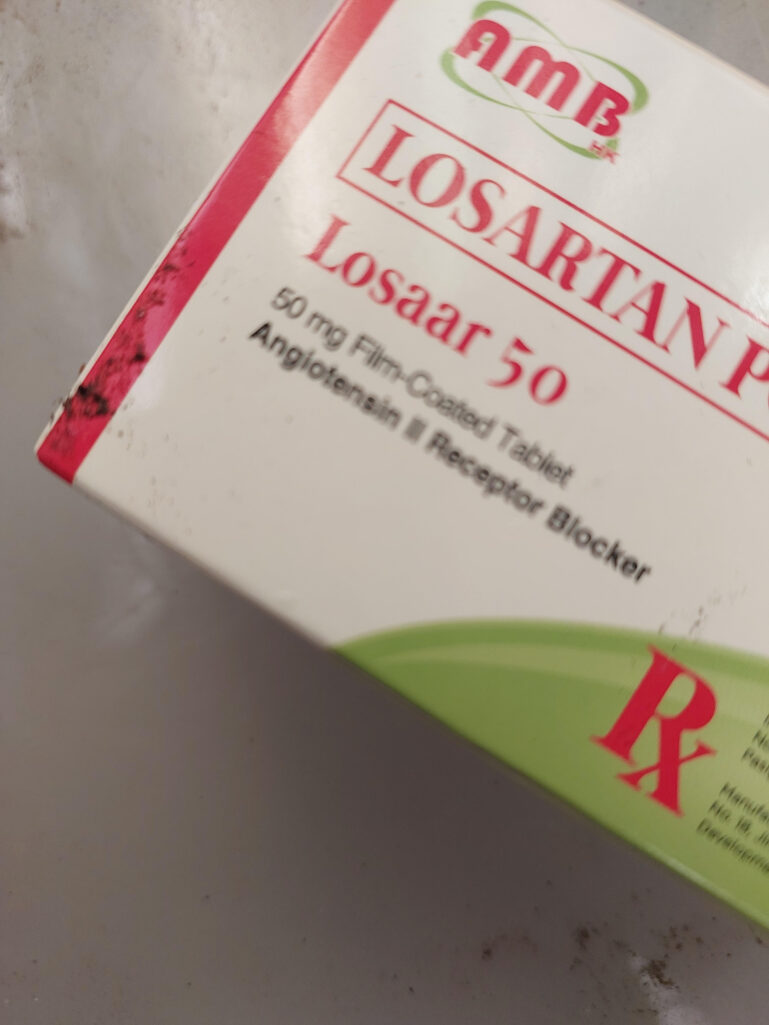
When I was first told tht I had to take Losartan, I did not know what to make of it. I was young. Or youngish… just a little over 30. Was this going to be a forever thing? Was it safe? Would I feel different?
Losartan is one of the most widely prescribed blood pressure medications in the world. It belongs to a class of drugs called Angiotensin II Receptor Blockers (ARBs). Here is how it works:
Your body produces a hormone called angiotensin II. This hormone does two things: it tells your blood vessels to tighten and constrict, and it signals your kidneys to hold onto sodium and water — both of which raise blood pressure.
Losartan works by blocking the receptors that angiotensin II normally binds to. Without that binding, your blood vessels relax and widen, your kidneys release more fluid, and your blood pressure drops.
Losartan is FDA-approved to treat:
- High blood pressure (hypertension) in adults and children aged 6 and older
- Diabetic kidney disease in patients with Type 2 diabetes and hypertension
- Reduction of stroke risk in patients with hypertension and left ventricular hypertrophy (enlargement of the heart)
It comes as an oral tablet, typically taken once a day — with or without food.
The usual starting dose is 50 mg daily, and your doctor may adjust this up to 100 mg depending on your response. It is important to know that blood pressure begins improving within the first week, but the full effects may take 3 to 6 weeks to become apparent.
One critical point: Losartan controls hypertension — it does not cure it.
If you stop taking it, your blood pressure will rise again.
This is why it is called a maintenance medicine.
Why Maintenance Medicine Matters: The Case for Consistency
I used to think, “If I feel fine, why do I need to keep taking the pill?” It took a while to understand that feeling fine IS the goal — and it is the medicine making that possible.
Stopping maintenance medicine abruptly is dangerous. In fact, one of the most common causes of hypertensive emergencies — dangerously high blood pressure events — is the abrupt discontinuation of medication.
Your arteries do not suddenly become normal; they rebound, often harder than before.
It is very important that you take your medicine exactly as directed and that you keep your appointments with your doctor even if you feel well. Remember that this medicine will not cure your high blood pressure but it does help control it.
Think of it like glasses for poor vision. You do not stop wearing your glasses because you can see clearly with them. The glasses are why you can see clearly.
Pros and Cons of Maintenance Medicines Like Losartan
Like any medical treatment, maintenance medicines come with trade-offs. Here are the pros and cons:
| Pros of Maintenance Medicines (e.g., Losartan) | Cons / Considerations |
| Controls blood pressure around the clock | Must be taken every day — even when feeling fine |
| Reduces risk of stroke, heart attack, and kidney failure | May cause mild side effects: dizziness, stuffy nose, or muscle cramps |
| Protects the kidneys — especially for diabetic patients | Requires regular blood pressure and lab monitoring |
| Once-daily dosing — easy to incorporate into routine | NOT safe during pregnancy — always inform your doctor |
| Well-tolerated by most patients, fewer side effects than older drugs | Does not cure hypertension — only controls it |
| Available as affordable generic medication (Losartan) | Stopping abruptly can cause dangerous BP spikes |
A Brief History: We Did Not Always Have These Options
Before the mid-20th century, there were no effective medicines for high blood pressure. Doctors in the 1900s resorted to extreme sodium restriction (think: a diet of almost nothing but rice), surgery to cut parts of the nervous system, or injections that induced fever to temporarily lower pressure — all with significant side effects and limited results.
The first chemical treatment, sodium thiocyanate, was used around 1900 but was widely unpopular due to toxicity. Drugs developed after World War II, like reserpine and hydralazine, were more effective but still difficult to tolerate.
The real breakthrough came with the development of orally available, well-tolerated antihypertensive agents.
Losartan, introduced in the 1990s, represented a major step forward as the first ARB approved for clinical use — offering effective blood pressure control with a significantly better side effect profile compared to older drug classes.
Today, treating hypertension with medication is associated with significantly improved life expectancy. It is one of the clearest success stories in modern medicine.
What You Should Do Next
If you have never had your blood pressure checked — go get it checked. It takes less than two minutes and could save your life.
If you have already been diagnosed with hypertension:
- Take your medicine every single day, at the same time
- Do not skip doses because you feel well — that is the medicine working
- Monitor your blood pressure at home and keep a log
- Attend your follow-up appointments
- Tell your doctor about any side effects — there are options if one medicine does not suit you
- Make lifestyle changes to support your medication: less salt, more movement, better sleep
And if you are 40 and just received a diagnosis — you are not alone, and you are not too young.
You are actually lucky to know now.
Managed well, high blood pressure does not have to define your health. It just means paying closer attention to it.
The pill on the bedside table is not a sign of weakness. It is a commitment — to yourself, your heart, and the people who need you around for a long time.
Important: This article is for informational purposes only and is not a substitute for professional medical advice. Always consult your doctor before starting, changing, or stopping any medication.
