Your complete guide to being prepared for life’s unexpected moments
Every household should have at least one well-stocked first aid kit stored somewhere easily accessible but out of reach of young children.
The American Red Cross echoes this — and for good reason.
Most accidents happen in the home.
A kitchen burn, a deep cut while gardening, a child’s scraped knee that won’t stop bleeding — these are everyday situations that can be managed quickly and effectively if you have the right supplies on hand.
Tthe contents of your kit should be tailored depending on the number of people it needs to protect and any special medical needs in your household, such as allergy kits for people with insect sting or food allergies.
The key benefits of having a first aid kit at home include:
- Immediate response to injuries before medical help arrives
- Prevention of minor wounds becoming infected or worsening
- Peace of mind for parents and caregivers
- Life-saving potential in cardiac events — aspirin kept in a kit can be critical during a suspected heart attack in adults
- Ability to manage allergic reactions, sprains, burns, and cuts
The American Red Cross recommends checking your first aid kit every 3–6 months to replace used or expired items.
First Aid Kits in the Workplace
Whether you work in a quiet office or a busy warehouse, workplace accidents happen — and a first aid kit is your first line of defense.
| Item | Purpose |
| Analgesic (non-drowsy) | Pain relief |
| Bandage compresses | Wound coverage and pressure |
| CPR breathing barrier | Safe rescue breathing |
| Burn dressings (min. 12 sq. in.) | Treat burns |
| Cold packs (min. 4×5 inches) | Reduce swelling and pain |
| Eye coverings | Eye injury protection |
| Eye/skin wash (4 fl. oz.) | Flush chemical exposure |
| Hand sanitizer (61%+ ethyl alcohol) | Hygiene and infection prevention |
| Roller bandages | Wound wrapping and support |
| Nitrile or vinyl protective gloves | Protect responder and patient |
Remember: having a kit is not enough. You also need at least one employee be trained and prepared to use it. Untrained staff plus an unstocked kit equals a serious compliance risk and, more importantly, a real danger to your team.
First Aid Kits in Your Car
A first aid kit is one of the most important items you can include in any emergency kit, and your car is no exception.
Car accidents, unexpected medical events, helping another stranded motorist — all of these situations are made better with a kit in your glove compartment or trunk.
In addition to standard first aid supplies, a car emergency kit should also include:
- Road flares or reflective triangles for visibility
- Jumper cables and a tire repair kit
- Emergency blankets and hand warmers (especially in cold climates)
- A flashlight with extra batteries
- Non-perishable snacks and water (1 gallon per person per day)
- A seat belt cutter and window breaker tool
- A charged cell phone or portable charger
- A list of emergency contacts and personal medical information
Carrying a First Aid Kit in Your Bag
This is one of the most overlooked habits — but one of the most practical.
Emergencies don’t only happen at home or at work.
They happen at the park, at a restaurant, on a hiking trail, at a school event.
A portable personal kit doesn’t need to be heavy or bulky. A compact pouch with the basics can fit in a backpack, handbag, or school bag with ease. Consider a personal kit that includes:
- Adhesive bandages in assorted sizes
- Antiseptic wipes and antibiotic ointment
- A small roll of medical tape
- Pain relievers (ibuprofen or acetaminophen)
- Antihistamine tablets (for allergic reactions)
- A CPR face shield
- Personal prescription medications
- Emergency contact card
If you have family members with special medical needs — such as severe allergies requiring an epinephrine auto-injector (EpiPen) — it is highly recommended that you always carry those specific supplies when going out.
What Should Be in a Basic First Aid Kit?
| Category | Items |
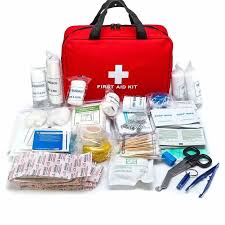
| Bandages & Dressings | Adhesive bandages (assorted sizes), butterfly bandages, fingertip/knuckle bandages, elastic wrap bandages, nonstick sterile pads, gauze pads (4×4 and 8×10 inches), roller gauze, triangular bandage/sling |
| Wound Care | Antiseptic wipes, antibiotic ointment, hydrogen peroxide, adhesive tape, cotton balls and swabs, super glue (for small cuts) |
| Medications | Pain relievers (acetaminophen/ibuprofen), aspirin (for adults — heart emergency), antihistamine (diphenhydramine), hydrocortisone cream, anti-diarrhea medicine, cough and cold medicine, aloe vera gel, calamine lotion |
| Tools & Equipment | Tweezers, scissors, digital thermometer, aluminum finger splint, instant cold packs, CPR face shield, nitrile gloves (2+ pairs), eye wash solution, eye shield or pad, emergency blanket |
| Reference | First aid manual or instruction booklet, list of emergency contacts, personal medical information |
The Most Important Items in Any First Aid Kit
Not all items are equal when it comes to urgency. These are the items most critical to have ready:
- Nitrile gloves — Protect both the responder and the patient. Non-latex options are safest.
- CPR face shield — Essential for delivering rescue breaths safely. Should be individually sealed with clear printed instructions.
- Adhesive bandages — For the most common everyday injuries.
- Gauze pads and roller bandages — For larger wounds, especially when bleeding needs to be controlled.
- Instant cold packs — For sprains, swelling, and pain relief.
- Antiseptic wipes and antibiotic ointment — To clean and protect wounds from infection.
- Aspirin — Can be life-saving for adults experiencing chest pain or a suspected heart attack. Always call emergency services first.
- Epinephrine auto-injector (EpiPen) — If prescribed, this is non-negotiable for those with severe allergies.
- First aid manual — Especially important if you have not had formal training.
Where to Buy a First Aid Kit
The good news is that first aid kits are widely available and affordable. Here are your best options:
- American Red Cross Store (redcross.org) — Sells purpose-built kits for the home, car, workplace, and travel, ranging from 40-piece to 137-piece sets.
- Local drugstores and pharmacies — Most carry pre-assembled kits you can purchase off the shelf.
- Amazon and online retailers — Offer a wide range of options from brands like First Aid Only, AAA, and Mayday.
- American Heart Association (cpr.heart.org) — Sells CPR & First Aid training kits with practice materials.
- Workplace safety suppliers
- DIY — You can also build your own kit using a durable waterproof container. This lets you customize items to your household’s specific needs.
Whichever route you choose, the Red Cross advises checking your kit every 3–6 months to replace expired items and restock supplies that have been used.
A More Extensive First Aid Kit
If you want to go beyond the basics — whether for a larger household, a remote location, or higher-risk activities like hiking, camping, or boating — consider adding the following advanced items to your kit:
| Advanced Item | Why It Matters |
| Tourniquet (e.g., CAT Gen7) | Stops severe limb bleeding in trauma situations |
| Hemostatic gauze (e.g., Celox Rapid) | Controls life-threatening bleeding when standard gauze isn’t enough |
| Emergency pressure dressings | For serious wound compression |
| Chest seal (vented) | For penetrating chest wounds |
| Hypothermia rescue blanket (Mylar) | Prevents dangerous heat loss |
| Splints (SAM splint or finger splints) | Immobilize fractures and dislocations |
| Burn dressings and gel | Specialized treatment for burns |
| Irrigation syringe | Thorough wound cleaning |
| Oral airway kit / pocket mask | Assists breathing in unconscious patients |
| Blood pressure cuff and stethoscope | Monitor vital signs |
| Glucose tablets | For diabetic emergencies |
| AED (Automated External Defibrillator) | Life-saving device for cardiac arrest |
| Emergency hand-crank weather radio | Stay informed during disasters |
| Waterproof container | Protect kit contents in all conditions |
For vehicle kits, the First Responder Vehicle Kit (originally developed in cooperation with Denver International Airport) includes trauma items like a combat tourniquet, hemostatic gauze, chest seals, and an emergency blanket — all organized for easy access even by non-medical personnel.
The Critical Need to Learn CPR and Emergency Life-Saving Skills
Here is the most important thing I learned in all my research: a first aid kit is only half the solution.
The other half is knowledge.
As CPR1.com puts it, “a well-stocked kit is only useful if you know how to use its contents under pressure.”
https://www.instagram.com/p/CsLblz9t7z9
According to the American Heart Association, about 20% of cardiac arrests happen in public places.
When someone goes into cardiac arrest, every minute without CPR reduces their survival chance by roughly 10%. The 4 to 10 minutes it takes an ambulance to arrive can simply be too long. Bystander CPR doubles or even triples the chance of survival.
Here is an overview of the key life-saving skills worth learning:
| Skill / Course | Provider | Who It’s For |
| CPR (Cardiopulmonary Resuscitation) | Philippine Red Cross | Everyone |
| AED (Automated External Defibrillator) Use | Philippine Red Cross | Everyone |
| First Aid Certification | Philippine Red Cross | Everyone |
| BLS (Basic Life Support) | Philippine Red Cross | Workplace / Healthcare |
| Heartsaver First Aid CPR AED | Philippine Red Cross | Non-medical workers |
| PALS (Pediatric Advanced Life Support) | Philippine Red Cross | Childcare / Healthcare |
| Heimlich Maneuver (Choking) | Philippine Red Cross | Everyone — especially parents |
| Wound Packing & Tourniquet Application | Philippine Red Cross | Anyone, especially in high-risk areas |
Pros and Cons of Having a First Aid Kit
No discussion would be complete without an honest look at both sides:
| PROS | CONS / LIMITATIONS |
| Immediate response to injuries — no waiting | False sense of security if untrained |
| Can prevent minor injuries from becoming serious | Kits expire and must be regularly checked and restocked |
| Potentially life-saving in cardiac or trauma events | Pre-made kits may include items you don’t actually need |
| Provides peace of mind for families | Quality varies widely — cheap kits may use inferior materials |
| Legally required in workplaces | Cannot replace professional medical care |
| Relatively inexpensive — especially vs. an ER visit | Items may be used incorrectly without proper training |
| Customizable to your specific needs | Takes up space, especially larger or vehicle kits |
| Helps you assist others in emergencies too | Some advanced items require training to use safely |
The bottom line on cons: most of them are solved by two things — proper training and regular maintenance. A kit that is checked every 3–6 months and paired with even a basic first aid certification is a genuinely powerful tool.
Final Thoughts
I started this journey knowing nothing about first aid kits.
What I discovered is that this is one of the simplest, most affordable, and most impactful things you can do for yourself and your loved ones.
You don’t need to be a doctor.
You don’t need an elaborate setup.
You just need a well-stocked kit, a basic understanding of how to use it, and ideally some first aid and CPR training from the Philippine Red Cross.
Put one in your home.
Put one in your car.
Keep one in your bag.
Find out where yours is at work.
Check it every few months.
And take a CPR class — even just once.
Because when the moment comes, you’ll be glad you did.
