
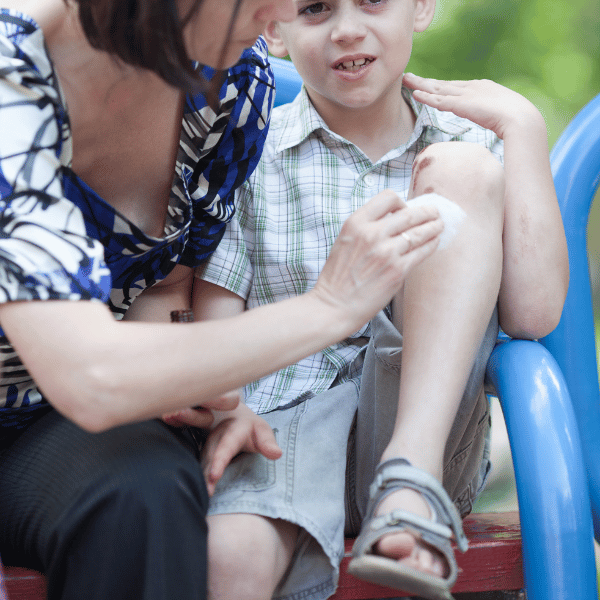
My son Lyle is… a handful.
He falls, he trips, he runs into things… like every little energetic boy in the world does.
And when he was younger, especially during the pandemic when his mom was home more, there was one cure for every scraped knee, every bumped head, every stubbed toe.
His mom would kiss it.
And I am not exaggerating when I say the crying stopped almost immediately.
Like someone flipped a switch.
These days, I am the main caretaker… and I have to be honest, my kisses do not quite have the same power.
He still comes to me, and I still kiss the boo boo, but the magic is a little different.
Maybe a little less instantaneous.
Though I will say this — Lyle has also become noticeably better at navigating the world without injuring himself, and I have a theory about that too.
When you know the all-powerfull healer is not always available, maybe you learn to be a little more careful.
This one is for the mothers. And for all of us who grew up believing a kiss could fix anything.
What Is the ‘Mommy’s Kiss Effect’?
It sounds like something you would say to a toddler to get them to stop crying… but it is actually a real thing that researchers have studied.
The ‘mommy’s kiss effect’ refers to how physical touch, soothing words, and emotional closeness tht only a mom can give — can genuinely reduce a child’s experience of pain.
The mechanism (how it works in the body) involves the brain releasing natural chemicals in response to comfort and safety.
Think of it like this: pain is not just the injury itself — it is also your brain’s interpretation of that injury.
| Term | What It Means in Plain Language |
| Oxytocin | The ‘bonding hormone’ — released during hugs and comforting touch; reduces stress and pain perception |
| Endorphins | Natural painkillers your brain makes; released when you feel safe, loved, or comforted |
| Cortisol | The stress hormone — high when a child is scared or in pain; drops significantly with maternal comfort |
| Co-regulation | When a child’s nervous system calms down by syncing with a calm caregiver’s nervous system |
Warning Signs: When the Kiss Is Not Enough
| Sign After a Bump or Fall | What It Might Mean |
| Child does not stop crying after 15 to 20 minutes | Pain may be more significant than it appears — check for injury |
| Swelling, deformity, or inability to move a limb | Possible fracture — needs X-ray |
| Head bump followed by vomiting, confusion, or unusual sleepiness | Possible concussion or head injury — go to ER immediately |
| Wound that will not stop bleeding after 10 minutes of pressure | May need stitches or medical closure |
| Child becomes very withdrawn or unusually quiet after a fall | Could indicate internal pain they cannot express — get assessed |
| Excessive fear, clinginess, or regression (acting younger than usual) after a scare | May indicate emotional trauma worth discussing with a pediatrician |
If any of these signs appear, head to the nearest emergency room. In Davao, Southern Philippines Medical Center (SPMC) in Bajada handles pediatric emergencies with lower-cost options for PhilHealth members.
Davao Doctors and San Pedro Hospital are good private options.
For head injuries especially, do not wait it out at home — a pediatric ER visit at a government hospital can cost as little as PHP 200 to PHP 500.
If you’re in Calinan, make sure you visit the Dr. Lorenzo B. Principe Clinic and Drugstore Inc. at Magsaysay.
The Details: Why Mommy’s Kiss Actually Works
When Lyle was small and his mom kissed his booboo, something real was happening in his little body.
Researchers in child development and neuroscience (the study of the brain and nervous system) have found that a mother’s touch activates what is called the oxytocin system.
Oxytocin is sometimes called the bonding hormone — it is the same chemical released during breastfeeding, during a long hug, or when you feel genuinely cared for. When a child is hurt and crying, their cortisol levels — the stress hormone — spike.
A mother’s calm voice, gentle touch, and a kiss can bring those cortisol levels back down remarkably fast.
There is also something called co-regulation, which is a fancy term for something every Filipino mom does without even knowing it.
When a mother holds a crying child and stays calm herself, the child’s nervous system literally begins to sync with the mother’s.
The heartbeat slows.
The breathing evens out.
The brain stops interpreting the bump as a catastrophe and starts filing it under ‘okay, I survived.’
When I grew up, all my siblings — every single one — looked to our mom for this exact thing. It did not matter if it was a scraped knee from the street or something more emotional.
Her presence was the treatment.
I did not know there was science behind it. I just knew it worked.
And thank god I had a very calm mom who was always ready to give a hug or kiss us when we needed it.
And here is the interesting part: it is not exclusive to mothers.
Fathers, grandparents, and any consistent, loving caregiver can develop this effect.
But research does suggest that in early childhood, the primary caregiver — who in many Filipino households is still the mother — builds the strongest association.
My kisses work too, just maybe a little less efficiently.
(I choose to believe it is because Lyle is getting braver, not because I am less magical.)
What You Can Actually Do About It
- Stay calm yourself when your child gets hurt — your nervous system sets the tone for theirs; panic makes their pain feel bigger
- Make physical contact immediately — hold them, pick them up, or at minimum put a hand on their back; touch triggers the oxytocin response
- Use a calm, low, steady voice instead of matching their distress — ‘It’s okay, I’ve got you’ works better than ‘Ay! What happened?!’
- Acknowledge the pain before trying to minimize it — ‘That must have really hurt’ is more effective than ‘Wala lang yan’ (that’s nothing)
- Follow up with a kiss or gentle blow on the affected area — yes, this is real; the act signals safety to the child’s brain
- After the immediate crying passes, gently redirect attention to something positive — recovery is faster when the brain shifts out of threat mode
- For recurring fear or excessive pain reactions, keep a simple log to share with your pediatrician at the next visit
These are all free.
No pharmacy run needed or herbal remedies.
The most powerful tools are already in you.
The challenge for most Filipino parents — especially dads — is learning to be calm first and fix things second.
We tend to reach for something to do.
Sometimes the most effective thing is just to be there.
Pros and Cons: Leaning Into Emotional Comfort as a Health Tool
| Reasons to Embrace It | Why Some Filipino Parents Hesitate |
| Backed by science — oxytocin and co-regulation are real and measurable | Fear of raising a soft child |
| Builds long-term emotional security and resilience in children | Busy schedules — work, traffic, chores make it hard to stop and be present |
| Free, always available, no side effects | Not modeled growing up — some parents were not comforted this way themselves |
| Reduces dependency on unnecessary medication for minor pain | Feels unscientific — ‘kiss lang, ok na?’ seems too simple to be true |
| Strengthens parent-child bond and trust over time | Dads especially may feel awkward or unsure how to do this naturally |
Costs in the Philippines (Davao)
The ‘mommy’s kiss’ itself costs nothing. But if you want professional support for a child’s emotional health or pain management, here are realistic numbers in Davao:
| Service | Approximate Cost in Davao |
| Pediatric consultation (private clinic) | PHP 500 to PHP 1,200 |
| Pediatric consultation (SPMC or government hospital) | PHP 100 to PHP 300 (reduced with PhilHealth) |
| Child psychologist consultation (for emotional trauma or anxiety) | PHP 1,200 to PHP 2,500 per session |
| Pediatric ER visit for minor injury | PHP 200 to PHP 800 at government hospital |
| Parenting skills seminar or family counseling (NGO/church-based) | Often free or low-cost in Davao community programs |
Call ahead to confirm rates, especially at private hospitals where consultation fees can vary. PhilHealth can offset costs at accredited government facilities like SPMC.
To All The Moms, Happy Mother’s Day!
This Mother’s Day, I think about my mom and every kiss she gave all of us growing up.
And I think about Lyle’s mom and what she gives him without even knowing she is doing something profund.
If you are a parent reading this, lean into the comfort.
Do not be afraid to be the safe place your child runs to.
And if your child shows any persistent pain, emotional distress, or anything that does not resolve with comfort, please see a real pediatrician or child health professional.
Not someday.
Soon.
The kiss is powerful, but it works best as a first step, not the only one.

1 thought on “How Mommy’s Kiss Cures Any Boo Boo”