
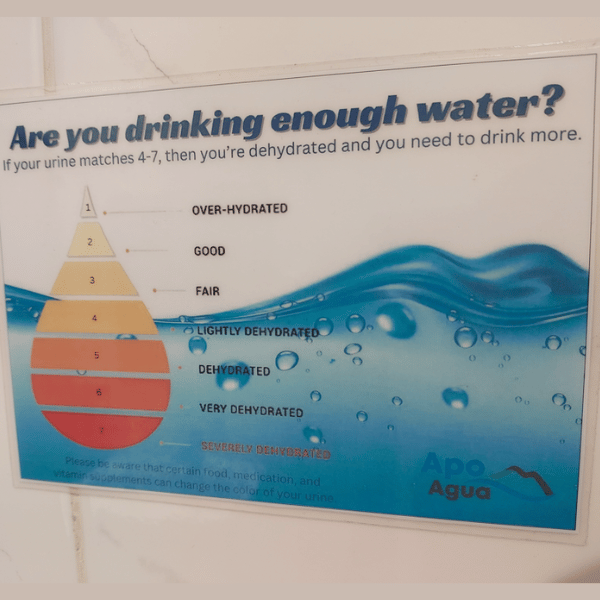
I recently visited the Apo Agua facility — the Davao City Bulk Water Supply Project along the Davao-Bukidnon Highway in Barangay Gumalang — and because I drank way too much coffee, I ended up using their restroom.
Which is not usually where one expects to be educated about hhydration.
But there it was, mounted cleanly on the wall: a seven-stage urine color chart asking the question most of us never think to ask ourselves. Are you drinking enough water?
I looked at it.
I thought about what I had drunk that morning.
And I realized, as I suspect most Filipinos would if they were honest, that I was probably somewhere around a four.
Maybe a five on a hot day.
The chart was simple, visual, and mildly alarming — exactly the kind of health information that should be on more walls in more places, not just inside one of the most impressive water facilities in Southeast Asia.
For context: the Apo Agua facility is the largest private bulk water supply project in the Philippines, with a 300 million liters per day (MLD) water treatment capacity.
It runs on its own hydroelectric power plant, making it the first water-energy nexus facility of its kind in the region.
The water it produces goes through a DOH-accredited laboratory for quality testing before reaching the Davao City Water District (DCWD) network.
This is not a casual infrastructure project. It is a serious, modern water system — and it has made Davao’s tap water among the cleanest and safest in the country.
The Seven Stages of Hydration: What Your Urine Is Actually Telling You
The chart I saw at Apo Agua reflects what urologists (doctors who specialize in the urinary system) and sports medicine researchers have been saying for years: urine color is one of the most reliable, real-time indicators of hydration status available to the average person.
No blood test needed.
No clinic visit.
Just pay attention to your piss for some peace of mind.
The sign’s advice was direct: if your urine matches stages 4 through 7, you are dehydrated and need to drink more.
Here is the full breakdown:
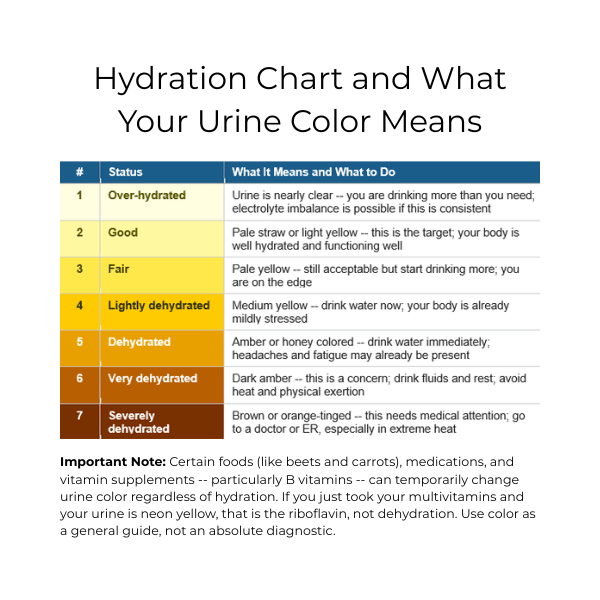
| # | Status | What It Means and What to Do |
| 1 | Over-hydrated | Urine is nearly clear — you are drinking more than you need; electrolyte imbalance is possible if this is consistent |
| 2 | Good | Pale straw or light yellow — this is the target; your body is well hydrated and functioning well |
| 3 | Fair | Pale yellow — still acceptable but start drinking more; you are on the edge |
| 4 | Lightly dehydrated | Medium yellow — drink water now; your body is already mildly stressed |
| 5 | Dehydrated | Amber or honey colored — drink water immediately; headaches and fatigue may already be present |
| 6 | Very dehydrated | Dark amber — this is a concern; drink fluids and rest; avoid heat and physical exertion |
| 7 | Severely dehydrated | Brown or orange-tinged — this needs medical attention; go to a doctor or ER, especially in extreme heat |
Important Note: certain foods (like beets and carrots), medications, and vitamin supplements — particularly B vitamins — can temporarily change urine color regardless of hydration. If you just took your multivitamins and your urine is neon yellow, that is the riboflavin, not dehydration. Use color as a general guide, not an absolute diagnostic.
How Much Water Do You Actually Need?
The classic ‘eight glasses a day’ recommendation is a starting point, not a prescription.
The reality is that your water needs depend heavily on your body weight, activity level, and the environment you are in. In Davao right now, with the heat index regularly pushing past 38 to 40 degrees Celsius in peak hours, the baseline recommendation is not enough for most active adults.
| Activity Level | Estimated Daily Water Need | Notes |
| Sedentary — mostly sitting, office work | 2.0 to 2.5 liters | Increase if air-conditioning is dry and dehydrating |
| Lightly active — walking, light chores | 2.5 to 3.0 liters | More in hot weather; drink before you feel thirsty |
| Moderately active — exercise 3 to 5 days/week | 3.0 to 3.5 liters | Replenish during and after activity, not just after |
| Highly active — daily intense exercise or outdoor work | 3.5 to 4.5 liters or more | Consider electrolytes; water alone may not be sufficient |
| Children (6 to 12 years old) | 1.5 to 2.0 liters | More during PE, outdoor play, or hot afternoons |
Thirst is a late signal.
By the time you feel thirsty, your body is already mildly dehydrated. In the current weather, the practical rule is to drink before you are thirsty, especially in the mornings before going out and after any physical activity.
About Davao’s Tap Water
If you live in Davao City and are served by the Davao City Water District network, you can drink straight from the tap.
This is not true of most Philippine cities.
The Apo Agua facility — which now supplies roughly 78% of DCWD’s daily water — puts that water through rigorous multi-stage treatment and quality testing in a DOH-accredited laboratory before it reaches your faucet.
The system is modern, automated, and built to international standards.
That matters for hydration because one of the most common reasons Filipinos underdrink at home is the habbit of waiting for water to be boiled or for water deliveries to arrive.
In Davao, that barrier largely does not exist for DCWD-connected households.
Fill a glass from the tap.
Drink it.
Refill.
The infrastructure your city built and your water bills fund is genuinely good.
Use it.
Although I won’t stop you from boiling your water if you still feel the need to do it.
Or run it through purifiers.
Practical Ways to Stay Hydrated in This Heat
- Start the day with a full glass of water before coffee — your body has been going eight hours without fluids overnight
- Keep a water bottle visible at your desk or workspace — out of sight means out of mind; the physical reminder matters more than you think
- Eat water-rich foods — watermelon, cucumber, oranges, kamatis (tomatoes), and coconut water all contribute to hydration and are cheap and available everywhere
- Limit softdrinks and sweetened drinks during the day — they do not hydrate the way water does and the sugar load actually increases your fluid needs
- If you are exercising or walking outdoors in peak heat (10AM to 3PM), drink 200 to 300ml of water every 20 to 30 minutes, not just before and after
- Use the urine chart — check your color once in the morning and once in the afternoon; it takes two seconds and tells you more than most people realize
- For children, set a schedule — kids do not self-regulate hydration well, especially when they are playing; remind them to drink every hour
The sign in that Apo Agua restroom did something useful for someone like me — it put a simple, visual tool in front of people at the exact moment they could use it.
I am trying to do the same thing here.
You do not need a fitness tracker or a health app to know if you are drinking enough.
You just need to pay attention to something your body is already showing you every time you use the bathroom.
In Davao, in this weather, dehydration is not a possibility — it is a daily reality for most people who are not actively managing their intake.
Headaches, fatigue, difficulty concentrating, irritability, muscle cramps… many of the things we attribute to stress or poor sleep are simply the body asking for water.
Start there.
And if you have not been to the Apo Agua facility, it is worth a visit — not just for the engineering, but for the remider that the water coming out of your tap in this city is something genuinely worth appreciating.
DISCLAIMER
This article is for informational purposes only and does not constitute medical advice. Please consult a licensed physician for diagnosis and treatment.
