
What to Do Because It Is Not Always Safe
I had just crawled into bed at 6AM after spending the entire night working on my personal website projects:
…shameless plug, I know…
Anyway… it was supposed to be Lyle’s first day of school so I thought a little shuteye before 9AM would give me back some energy to prepare brunch, clean him up and send him off to school for his afternoon session.
I was maybe an hour and a half into sleep when the shaking started.
It was violent and it made me spring into action.
I did not think.
I just grabbed Lyle, put my hand over his head, and ran.
The dining table was right there — I know the protocol, duck and cover, get under something solid — but I looked at that table and I looked at the front door and I made a split-second decision.
Four or five large strides to the front door.
We ran.
Lyle and I ended up in the garage, crouched beside the front wheel well of the Innova.
The two dogs, Apo and Axl, crowded around us.
I kept one hand over Lyle’s head and put my own head down on top.
Just in case of debris.
Outside, the tall palm trees were swaying. The neighbors were already outside.
The earthquake was measured at 6.2 to 6.4 magnitude. It struck Davao around 7:30 to 7:45 in the morning.
A little later, the Davao Convention Center caught fire. … and I was just there a few weeks ago to see the DAFI Artfest Saudade Opening Night. Sorry… can’t help it.
This earthquake triggered a memory of the 6.9 magnitude earthquake I experienced in Magsaysay in 2019 — standing onstage three kilometers from the epicenter, watching chaos consume a covered court in seconds — layering over everything like a second tremor.
(Side note to self, and I am leaving this in because it is true and somebody else probably needs the reminder: wear presentable underwear to bed. I hope my neighbor does not have any photographic evidence of my brown butt. Lyle saved my dignity by being the right size to cover the rest of my front.)
I am writing this article because Davao is not an island of safety.
We are in a seismically active zone.
We are coastally exposed.
We have buildings and events and bad luck.
Every person in this city should know what to do in three specific emergencies — not someday, not after the next one, but now.
Emergency One: Earthquake
During the Shaking
| If You Are Indoors | What to Do |
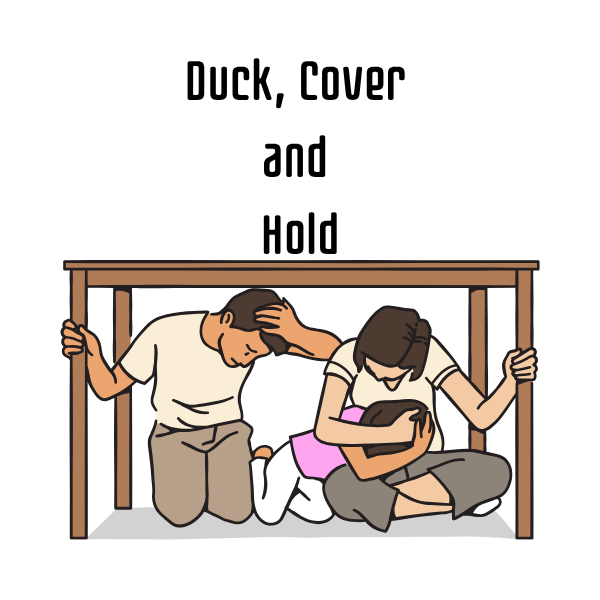
| Near a sturdy table or desk | DUCK — get low to the ground; COVER — get under the table and hold on; HOLD — grip the table leg and move with it until shaking stops |
| No table nearby | Drop to hands and knees; cover your head and neck with your arms; move against an interior wall away from windows |
| In bed | Stay in bed, roll face down, cover your head with a pillow; only move if you are directly under a heavy light fixture |
| In a high-rise | Do NOT use elevators; do not rush to the stairs during shaking; get low and cover first |
After the Shaking Stops: Evacuate
- Wait for shaking to fully stop before moving — 30 seconds minimum; aftershocks can begin within seconds
- Bring only essential items — go bag, phone, wallet, shoes; leave large belongings that slow you down
- Place both hands on top of your head as you exit — this protects you from falling objects and debris
- Walk briskly to assigned exits; be aware of the person in front and behind you — do not push
- Do not use elevators under any circumstances after an earthquake
- Once outside, move away from buildings, power lines, and trees; find open ground
- Check yourself and those around you for injuries before anything else
Note to Davao residents: follow the Davao City DRRMO (Disaster Risk Reduction and Management Office) on Facebook for official updates, evacuation routes, and aftershock advisories. Their page is the most reliable real-time source during emergencies.
… and they don’t have shameless plugs like me…
Emergency Two: Tsunami
Davao Gulf provides some natural protection, but Davao is not immune.
The 2019 Cotabato earthquake series triggered tsunami warnings for several Mindanao coastal areas.
After any strong earthquake near the coast — or if you are near the shoreline and feel prolonged shaking — assume a tsunami is possible and act immediately.
Do not wait for official confirmation. The window between a major undersea quake and the first wave can be as short as five minutes.
The Three Natural Warnings
- You feel a strong earthquake near the coast — this is your first signal
- The sea suddenly recedes dramatically, exposing the seafloor — this is the ocean pulling back before the wave; do not go look at the fish, go to high ground
- You hear a loud roaring sound from the ocean direction — the wave is coming
What to Do
| Step | Action |
| 1 — Move immediately | Do not wait for a siren or an announcement; go inland and upward at once |
| 2 — Get to high ground | Aim for at least 30 meters above sea level or 3 kilometers inland — whichever is faster to reach |
| 3 — Do not drive toward the shore | If you are in a car, drive inland; roads near shore will flood first |
| 4 — Stay high | Tsunamis come in multiple waves; the second or third is often larger than the first; do not go back until officials declare all clear |
| 5 — If you cannot reach high ground | Go to an upper floor of a reinforced concrete building — a last resort; wooden structures will not survive |
In Davao, know your elevation. If you live or work near the Davao Gulf coastline — Sasa, Bucana, Isla Verde, Toril — have a planned evacuation route to higher ground memorized before you need it. PHIVOLCS and DRRMO issue tsunami advisories, but the time between warning and wave is short. Your plan must already exist.
Emergency Three: Fire
The Davao Convention Center fire following the 6.2 to 6.4 magnitude earthquake is a reminder that emergencies do not always come alone.
Earthquakes rupture gas lines.
They spark electrical fires.
They knock over candles.
A building that survived the shaking can begin burning minutes later.
Fire preparedness is not separate from earthquake preparedness — it is part of the same emergency.
If a Fire Starts
- Alert everyone immediately — shout Fire and activate the nearest alarm if one is present; do not assume someone else has done it
- Call 911 Davao the moment you are safe — early notification saves structures and lives
—
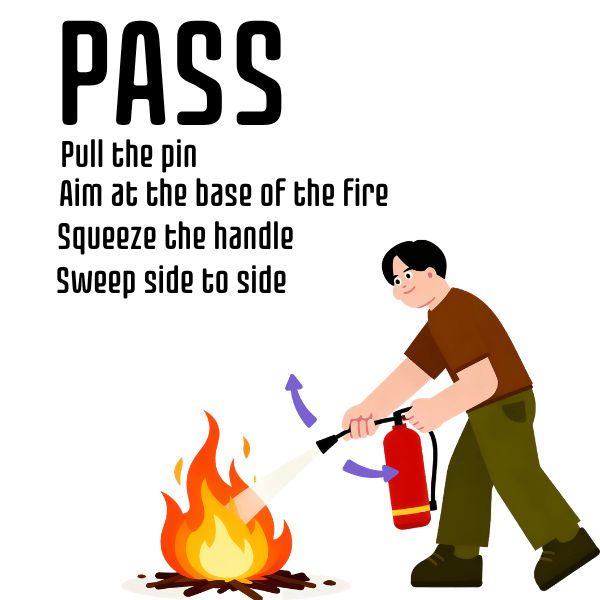
- If the fire is very small and you have a fire extinguisher, use the PASS method:
- Pull the pin,
- Aim at the base of the fire,
- Squeeze the handle,
- Sweep side to side — if the fire does not go out in ten seconds, leave immediately
—
- If you cannot control it, leave — close doors behind you as you exit; closed doors slow fire spread significantly and can save lives on the other side
- Feel doors before opening — if the door is hot, do not open it; use another exit or signal from a window
- Stay low — smoke kills faster than flames; toxic gases accumulate at ceiling level first; crawl if visibility drops
- Never use elevators during a fire — take the stairs; if stairs are blocked by smoke, return to your room and seal gaps under the door with cloth
If You Are Trapped
- Close all doors between you and the fire
- Seal door gaps with cloth, clothing, or anything available to slow smoke entry
- Signal from a window — wave something brightly colored; call out; do not jump unless fire is directly below and you have no other option
- Call 911 Davao and give your exact location and floor number
Prepare Before the Next One
Every emergency I have lived through — the 6.9 in Magsaysay, the fire that engulfed our building in Avenida, — has reinforced the same truth: the decisions you make in the first thirty seconds are made on instinct, not thought.
And instinct is only reliable if it has been trained.
I grabbed Lyle and ran because some part of my brain had already made that decision in advance.
I did not pause.
I did not think about whether it was the textbook correct move.
I acted.
That is what preparation actually produces — not a checklist you read during a crisis, but a set of automatic responses that fire before panic does.
Three Things to Have Before the Next Emergency
- A go bag — pre-packed with water, food for 72 hours, copies of important documents, a first aid kit, medications, a flashlight, and a whistle; we have covered this in detail here
- A hard hat or at minimum a folding emergency helmet — falling debris is what kills in earthquakes, not the shaking itself; a helmet costs far less than an ER visit, and we have written about this too
- A basic first aid kit at home — not a decorative tin with three plasters; a real kit with gauze, antiseptic, wound closure strips, a tourniquet, and a CPR face shield, etcetera
Lyle’s school called off classes that morning for everyone’s safety.
Good call.
I wouldn’t have allowed him to go to school regardless of an official suspension of classes or not. In an emergency, I want to be as near and ready to protect him as possible.
But school will resume, and Davao will wake up calm again, and everyone will slowly stop thinking about it… until the next one.
Do not be that person.
Use this window of opportunity to learn what to do while the memory is still fresh.
Know your DRRMO.
Know your evacuation routes.
Know what you would grab in thirty seconds.
Know where you would go.
Have the conversation with your family now.
This city is worth protecting.
So is the people in it.
Starting with the ones in your own house.
RELATED ARTICLES
What’s in an Emergency Go Bag and Why You Need One Now
Hard Hat: Why Every Filipino Home Should Have One
The Importance of a First Aid Kit at Home
DISCLAIMER
This article is for informational purposes only and does not constitute professional emergency management advice. Follow official instructions from Davao DRRMO, PHIVOLCS, and 911 Davao during actual emergencies.
